

Collagen, Glucosamine & Co.: What Do Your Dog's Joints Need?
Tanja WeinandThe joy of movement starts with well-nourished joints!
Whether it's boisterous romping, long walks or that little jump onto the sofa: your dog's joints are in action every single day. They make smooth movement possible, cushion strain and, together with muscles, tendons and ligaments, help keep your four-legged friend active.
But how do dog joints actually work? What changes as your dog gets older? And what role do nutrients such as collagen, glucosamine or omega-3 fatty acids play?
We'll show you what matters when it comes to joint health and how you can support your dog's joy of movement in the long term.
How are your dog's joints structured?
A joint connects two or more bones and allows them to move.
To keep movement as low-friction as possible, several structures work together:
- Joint cartilage: It covers the joint surfaces, distributes pressure and allows the bones to glide with as little friction as possible.
- Joint fluid: Known as synovial fluid, it supplies the joint cartilage with nutrients and contributes to the lubrication of the joint.
- Joint capsule and ligaments: They stabilize the joint and guide its movements.
- Muscles and tendons: They create movement and support stability.
Joint cartilage is particularly interesting. It consists of a specialized matrix that contains, among other things, collagen, proteoglycans and a lot of water.
This composition gives it its special mechanical properties.
What changes with age?
Over the years, various tissues in your dog's body change, including the joints.
Joint cartilage has a limited ability to adapt and repair itself. At the same time, years of strain and biological aging processes can lead to changes in the cartilage, joint capsule and other joint structures.
Some dogs develop osteoarthritis, a chronic joint disease that can affect not just the cartilage but the entire joint.
- Typical signs of joint problems may include:
- Difficulty getting up after longer periods of rest
- Less enthusiasm for jumping or climbing stairs
- A change in gait or lameness
- Stiffness after lying down
- Less willingness to go on longer walks
Important: Not every change in mobility is automatically a normal sign of aging. Anything unusual should be checked by a veterinarian so that possible pain or disease can be detected early.
What role do collagen and cartilage components play?
Joint cartilage is a fascinating tissue that has to withstand high loads.
Various structural building blocks play an important role in this.
Collagen – an important building block for stable and mobile joints
Collagen is one of the body's most important structural proteins and an essential component of cartilage, tendons, ligaments and bones. In joint cartilage, type II collagen in particular forms a stable fiber network that contributes to the strength and resilience of the tissue.
Hydrolyzed collagen is broken down into smaller, easily digestible collagen peptides. These provide the body with amino acids and peptides that are available for its own metabolism.
Collagen is also attracting growing scientific attention as a complementary joint nutrient. Initial studies in dogs provide interesting indications of possible positive effects on joint function and mobility.
Glucosamine – a building block of the body's own structures
Glucosamine is a natural compound produced by the body and plays an important role in building certain components of the cartilage matrix. Among other things, it is needed to form glycosaminoglycans, which contribute to the structure and functionality of joint cartilage.
Glucosamine has been used and scientifically studied as a complementary joint nutrient for many years. Its role in interaction with other cartilage components such as chondroitin is particularly interesting. Research continues to examine what additional contribution a targeted intake of glucosamine can make to joint function in dogs.
Chondroitin – for the elasticity and resilience of joint cartilage
Chondroitin sulfate belongs to the group of so-called glycosaminoglycans and is a natural component of the cartilage matrix. It is involved in binding water in the cartilage and thus contributes to its compressive elasticity and resilience – important properties for smooth movement.
In supplements, chondroitin is often combined with glucosamine, as the two substances perform different functions within the cartilage structure. This combination is therefore an interesting approach in nutritional joint support, and its additional benefit in dogs continues to be studied scientifically.
Which other nutrients are of interest for joints?
In addition to the well-known cartilage components, there are other ingredients that are used in joint supplements and studied scientifically:
Omega-3 fatty acids - valuable support for joint function
The long-chain omega-3 fatty acids EPA and DHA in particular are known for their involvement in various biological regulatory processes. For dogs with osteoarthritis, there is comparatively good scientific evidence that an adequate supply of EPA and DHA can support joint function and well-being. When choosing a supplement, however, what matters is which omega-3 fatty acids it actually contains and in what amount they are provided.
Green-lipped mussel – natural diversity from the sea
The New Zealand green-lipped mussel contains lipids, proteins and other natural components, among other things. Because of this composition, it has been used for many years in complementary joint support for dogs. Scientific studies provide indications of possible positive effects in dogs with joint problems.
MSM – an organic sulfur compound
Methylsulfonylmethane, or MSM for short, is an organic sulfur compound that is frequently used in joint supplements. Sulfur is a component of various compounds in the body and plays a role in, among other things, the metabolism of connective tissue components. MSM complements joint support as an ingredient in its own right and can be usefully combined with other nutrients such as collagen, glucosamine and chondroitin.
Boswellia and rose hip
Boswellia (frankincense) contains characteristic plant compounds, especially boswellic acids, which are being studied scientifically because of their biological properties. Of particular interest is their possible significance in connection with inflammatory processes. Rose hips provide a variety of natural plant compounds, including polyphenols, carotenoids and other compounds with antioxidant activity. Together, boswellia and rose hip complement the formula with valuable plant-based components and broaden the nutritional approach of well-rounded joint support.
Exercise and body weight: two decisive factors
As interesting as individual joint nutrients are, the foundation for long-term mobility doesn't lie in the food bowl alone. Regular, appropriate exercise helps maintain muscle mass, promotes coordination and helps put functional load on the joints. Activities that suit your dog's age, fitness level and state of health are particularly suitable. These include, for example, regular walks, controlled muscle training and, where appropriate, physiotherapy exercises. If your dog already has joint problems, an individually adapted level of exercise is especially important.
A healthy body weight
Excess weight increases the mechanical load on the joints and can make existing problems worse.
Maintaining an appropriate body weight is therefore one of the most important measures to relieve the joints in the long term. Especially in dogs with osteoarthritis, controlled weight loss can make an important contribution to improving mobility.
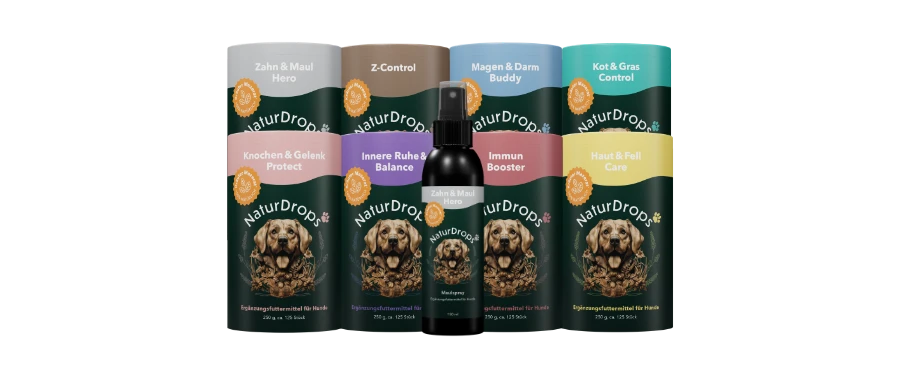
Our Joint-Mobility Complex: a well-thought-out combination of nutrients for dogs who love to move
With our NaturDrops Joint-Mobility Complex, we take a targeted multi-ingredient approach.
The formula combines selected structural building blocks, fatty acids and plant components that are of nutritional interest in connection with joint tissue and mobility.
These include:
- Hydrolyzed collagen: provides collagen peptides and amino acids.
- Glucosamine and chondroitin: compounds that also play a role in connection with the body's own cartilage structures.
- MSM: complements the formula as an organic sulfur compound.
- Green-lipped mussel: provides natural mussel components.
- Algae omega-3: complements the diet with valuable omega-3 fatty acids.
- Boswellia and rose hip: round out the complex with selected plant-based ingredients.
The ingredients are combined in a concentrated powder formula that is easy to mix into your dog's daily food.
The Joint-Mobility Complex is suitable as a targeted nutritional supplement for active and older dogs, as well as for dogs whose joint support is a particular focus.
In the case of existing joint diseases, a supplement can be a useful complement to veterinary treatment.
Conclusion: mobility is the result of many factors
Healthy joints depend on the interplay of various structures. Collagen, proteoglycans and other components ensure that joints can perform their tasks.
Selected nutrients can complement your dog's daily diet. At least as important are regular exercise, strong muscles and a healthy body weight.
Because the joy of movement comes about where nutrition, activity and good care come together. 💚

Quellen:
- https://pmc.ncbi.nlm.nih.gov/articles/PMC9499673/
- https://journals.plos.org/plosone/article?id=10.1371/journal.pone.0263971
- https://pmc.ncbi.nlm.nih.gov/articles/PMC11524509/
- https://pubmed.ncbi.nlm.nih.gov/17144822/
- https://pubmed.ncbi.nlm.nih.gov/20043801/
- https://pubmed.ncbi.nlm.nih.gov/18955269/
- https://www.aaha.org/resources/2022-aaha-pain-management-guidelines-for-dogs-and-cats/nonpharmacologic-modalities-for-pain-management/


