

Gut Flora in Dogs: Why a Balanced Gut Is So Important
Tanja WeinandA good gut feeling starts in the gut! Because far more happens there than just digesting food. The canine gut is home to a fascinating community of billions of microorganisms that together take on important tasks. They help utilize food components, interact with the immune system, and contribute to a well-functioning intestinal environment.
But what exactly makes for a balanced gut flora? Which factors influence it? And how can you support your dog with a well-thought-out diet?
What is gut flora in dogs?
Gut flora, scientifically also known as the gut microbiota, comprises all the microorganisms that live in your dog's digestive tract. These are mainly bacteria, but also yeasts, other fungi, and further microorganisms.
The term gut microbiome is often used synonymously. Strictly speaking, however, it includes not only the microorganisms but also their genetic information and the environment in which they live. Every dog has an individual composition of this microbial community. It is shaped by factors such as age, diet, environment, and health.
What matters is not that as many different bacteria as possible are present. Rather, the key is a well-functioning microbial community that suits the needs of the individual dog.
What tasks does the gut flora perform?
The gut flora is an important part of the digestive system and fulfills several functions at once.
1. It supports the utilization of nutrients
Certain gut bacteria can break down food components that the dog cannot fully utilize with its own digestive enzymes. These include, in particular, some types of fiber. Their fermentation produces, among other things, short-chain fatty acids such as acetate, propionate, and butyrate. These metabolic products are important for the intestinal environment. Butyrate, for example, serves as an important source of energy for the cells of the colon lining.
2. It interacts with the immune system
A large part of the body's immune activity takes place in connection with the gut. The gut microbiota is in close contact with the intestinal mucosa and the immune system located there. Among other things, it is involved in the development and regulation of immune responses. A well-functioning interplay between the intestinal barrier, microorganisms, and the immune system is therefore an important part of normal gut function.
3. It contributes to a stable intestinal environment
The various microorganisms interact with one another. For example, they compete for nutrients and habitat and produce different metabolic products. A well-functioning microbial community can help make it less easy for undesirable microorganisms to spread. However, this does not mean that there is one single ideal gut flora. The composition can vary considerably from dog to dog.
What influences the balance in the canine gut?
The gut flora is not a rigid system. It changes over the course of a lifetime and responds to various influences.
- Diet: The composition of the food influences which nutrients are available to the gut microorganisms. The type and amount of fiber in particular play a role here.
- Food changes: A sudden switch can temporarily lead to changes in digestion and stool consistency. That's why a gradual transition is often advisable.
- Medications: Antibiotics in particular can affect not only undesirable bacteria but also other members of the gut microbiota.
- Age and individual circumstances: Puppies develop their gut flora only over time. Changes can also occur in older dogs.
- Stress and illness: The gut is connected to the rest of the body via various nerve and signaling pathways. Strain and health problems can therefore also affect digestion.
Important to know: Not every change in the gut flora is automatically a problem. What always matters is how it interacts with your dog's overall health and well-being.
Fiber, prebiotics, and yeast cultures: What's behind them?
Certain food components can complement normal digestive function and the intestinal environment in different ways.
Fiber – versatile helpers for digestion
Dietary fibers are plant components that are not digested, or only incompletely digested, in the small intestine. Depending on the type, they can bind water, influence stool volume, or be fermented by gut microorganisms. Psyllium husk, for example, is known for its pronounced water-binding capacity. When combined with liquid, it forms a gel-like mass and can thereby support the regulation of stool consistency. Adequate fluid intake is always important here.
Prebiotics – food for selected gut microorganisms
Prebiotics are substances that are selectively utilized by certain microorganisms and can thereby confer a health benefit. A well-known example is inulin, which occurs in chicory root, among other sources. Such fermentable fibers can influence the activity of certain gut bacteria and the formation of microbial metabolic products. How well a dog tolerates certain prebiotic fibers depends, among other things, on the amount and on its individual digestion.
Yeast cultures – different properties and uses
Yeasts also play an interesting role in animal nutrition. However, the individual yeast species and their processed forms differ considerably. Brewer's yeast is used primarily as a source of nutrients and contains, among other things, proteins and various B vitamins. Certain live yeast cultures, for example selected strains of Saccharomyces cerevisiae, are also being studied in connection with digestive function. Whether a yeast culture has probiotic properties depends on the specific strain, its viability, and a correspondingly demonstrated effect. Not every yeast is automatically a probiotic.
How can you support your dog's gut balance in everyday life?
Gut-conscious feeding doesn't have to be complicated. Often it's the small, regular habits that create a good foundation.
-
Pay attention to high-quality, well-tolerated food.
A balanced diet that suits your dog's age and needs
forms the basis. -
Switch food gradually.
When planning a change of food, it can make sense to introduce the new food slowly over
several days. -
Provide plenty of fresh water.
Good fluid intake is especially important with high-fiber foods and supplements. -
Support a regular daily routine.
Regular feeding times, sufficient exercise, and appropriate rest periods
can contribute to an everyday routine that your dog tolerates well. -
Choose supplements to match your dog's needs.
Fiber, prebiotic ingredients, or selected yeast components can
complement daily feeding in a targeted way. What matters is a suitable formula,
the right dosage, and individual tolerance.
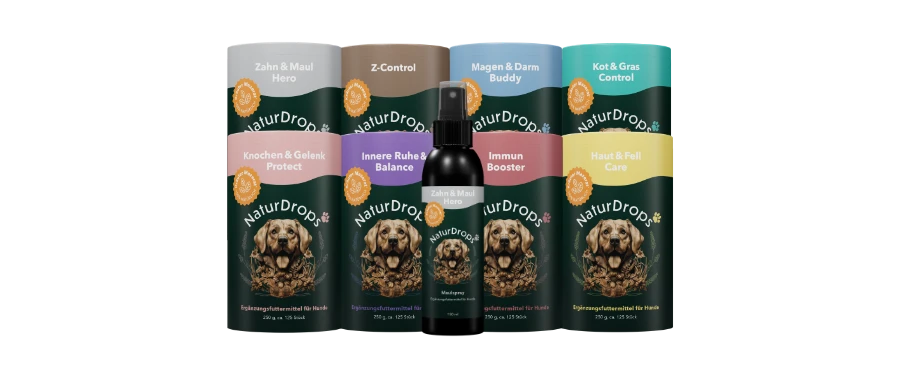
NaturDrops Gut-Balance Complex: Targeted supplementation for the canine gut
With our NaturDrops Gut-Balance Complex, we combine various nutritional approaches in a carefully balanced powder formula. These include, among others:
- Psyllium husk: Water-binding fiber to support normal stool consistency.
- Chicory root: Provides prebiotic fibers that can be used by selected gut microorganisms.
- Marshmallow, chamomile, and lemon balm: Traditionally used plants that complement our formula with their natural components.
- Selected yeast components: Round out the composition with additional nutritionally interesting components.
The Gut-Balance Complex was developed as a targeted supplement to daily feeding and can easily be mixed into dry or wet food.

Conclusion: Gut balance starts with a good foundation
Your dog's gut flora is a fascinating and dynamic ecosystem. It performs important tasks in utilizing food components, interacts with the immune system, and contributes to a well-functioning intestinal environment. A balanced diet, well-tolerated fiber, and a suitable feeding routine form the foundation for normal digestion.
Selected supplements can sensibly complement this foundation, tailored to your dog's individual needs.
Because a good gut feeling starts with the right balance. 💚
Quellen:
- https://www.frontiersin.org/journals/veterinary-science/articles/10.3389/fvets.2019.00498/full
- https://pubmed.ncbi.nlm.nih.gov/33653538/
- https://academic.oup.com/jvim/article/32/1/9/8449748
- https://pmc.ncbi.nlm.nih.gov/articles/PMC12734886/
- https://pmc.ncbi.nlm.nih.gov/articles/PMC10634211/
- https://pmc.ncbi.nlm.nih.gov/articles/PMC6766488/


