

Dental health in dogs: understanding the stages, taking the right action & preventing problems in the long term
Tanja WeinandIn this article, we show you how veterinarians classify dental health, how to spot problems early, and how to prevent them effectively with the right measures, including natural support.
Your dog's dental health is an often underestimated but crucial factor in their overall well-being. Problems in the mouth don't just affect the teeth and gums – they can put a strain on the entire body. Inflammation in the mouth has been shown to be linked to diseases of the heart, kidneys, and other organs. That makes it all the more important to understand early on what stage your dog's dental health is at – and what you can actually do about it.
The 5 stages of dental health in dogs
Veterinarians often use a staging system from grade 0 to 4 to assess the condition of the teeth and gums.
Grade 0 – Healthy
A healthy dog has clean teeth with no plaque. The gums are pink and firm and show no signs of inflammation. Bad breath is minimal or absent.
This condition is the goal of all dental care and is absolutely achievable with the right routine.

Grade 1 – Plaque & early gingivitis
At this early stage, a thin film (plaque) forms on the teeth. The gums may be slightly reddened but don't show any deep damage yet.
The good news: this stage is usually fully reversible – provided you act now.

Grade 2 – Tartar & gingivitis
If plaque isn't removed, it hardens and becomes visible as yellowish-brown tartar. The gums are clearly inflamed, often accompanied by bad breath. The first gum pockets may form.
At this point, home care is usually no longer enough, and a professional dental cleaning at the vet becomes advisable.

Grade 3 – Periodontitis (advanced)
Now the inflammation attacks the structures that hold the teeth in place. The gums recede, teeth can become loose, and pain develops.
By this point at the latest, treatment is urgently needed.

Grade 4 – Severe periodontitis
At this stage, there is massive inflammation, tooth loss, and often considerable pain. In addition, bacteria can enter the bloodstream and put a strain on organs such as the heart or kidneys.
This is an acute medical emergency.

Why dental care is so important
Many dog owners underestimate how quickly problems develop. Plaque forms just a few hours after eating. If it isn't removed, it mineralizes into tartar, which can then only be removed professionally.
Small dogs are especially often affected, as their tooth alignment and jaw size encourage the buildup of deposits.
Particularly important to know:
- Small dogs are affected much more often
- Many dogs are already at grade 2 without it being immediately noticeable
- Bad breath is almost always a warning sign and not a “normal condition”
What really helps: the 4 pillars of dental health
Effective dental care always consists of several building blocks. What matters is the combination, not any single measure.
1. Brushing – the gold standard
Regular tooth brushing is the most effective way to remove plaque. A daily routine is ideal.
What matters:
- 3–7 times a week, ideally daily
- Focus on the outer surfaces of the back teeth
- Build up slowly and positively
👉 If you only do one thing: this one.
Often, a clear improvement is visible after just a few weeks, especially when it comes to bad breath.
2. Chewing – natural support
Chewing is a natural mechanism for cleaning the teeth. Mechanical abrasion reduces plaque.
Particularly useful are:
- Chews with a suitable texture
- Regular, daily chewing
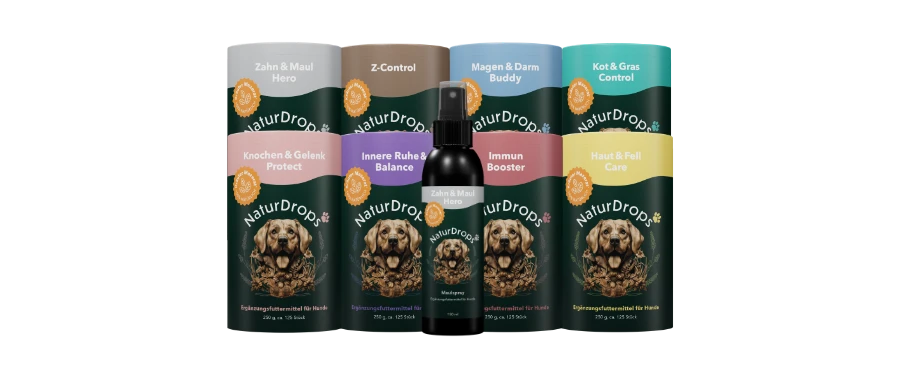
- Functional solutions such as the NaturDrops Tooth & Mouth Chew Sticks
👉 Important: chewing doesn't replace brushing, it's a useful complement to it.

They combine mechanical cleaning with functional ingredients and are easy to fit into everyday life.
3. Complementary care for the oral flora
In addition to mechanical cleaning, the bacterial balance in the mouth also plays an important role.
The following can be used for support:
- Herbal sprays such as the NaturDrops Tooth & Mouth Spray
- Supplements to support the oral flora

Important: these measures complement dental care, but they don't replace it.
4. Regular checks
A simple but often underestimated step is taking a regular look inside the mouth.
Watch out for:
- Discoloration (yellow or brown)
- Reddened gums
- An unpleasant odor
Early detection can spare your dog from needing extensive treatment under anesthesia.
When you should see the vet
Assessing the situation correctly spares your dog pain and saves you high treatment costs.
- Grade 0–1: No vet visit needed, focus on care
- Grade 2: Dental cleaning advisable
-
Grade 3–4: Urgent need for treatment

You should act immediately if you notice:
- Strong bad breath
- Bleeding gums
- Changes in eating behavior
- A visibly large amount of tartar
Understanding bad breath in dogs
Bad breath is a common cause for concern. Keep in mind: a neutral smell like in humans isn't realistic for dogs – but a strong, foul, or “fishy” odor is never normal.
The most common causes are:
- Plaque and bacteria (most common)
- Tartar and inflammation
- Anal gland problems
- Certain foods
A simple check helps you narrow it down:
- Only the mouth affected → usually the teeth
- Odor on the coat as well → more likely the anal glands
What really helps against bad breath
You can only achieve lasting improvement with the right combination:
- Brushing: the basis of all dental care
- Professional cleaning: if tartar is present
- Chewing: daily mechanical support
- Oral care: as a complement, with natural products such as NaturDrops Spray
Conclusion
Healthy teeth are no coincidence – they're the result of consistent care. If you start early and rely on a combination of brushing, chewing, and supportive oral care, you can safeguard your dog's dental health for the long term.
NaturDrops offers you modern, natural solutions that are easy to fit into everyday life – for more well-being, a better quality of life, and a radiant doggy smile.
Because in the end:
Healthy teeth mean a better quality of life – every day.
Quellen:
- https://www.aaha.org/resources/2019-aaha-dental-care-guidelines-for-dogs-and-cats/
- https://wsava.org/global-guidelines/dental-guidelines/
- https://afd.avdc.org/five-stages-of-pet-periodontal-disease/?utm_source=chatgpt.com
- https://pubmed.ncbi.nlm.nih.gov/9693607/
- https://www.sciencedirect.com/science/article/pii/S0195561698501052?utm_source=chatgpt.com


