

Gut health in dogs: Fermented herbs & prebiotics
Tanja WeinandGood ingredients are now considered the benchmark for high-quality dog nutrition. But whether they actually benefit the dog depends largely on gut health. This article highlights the importance of a balanced gut environment, explains the principle of bioavailability, and shows how fermented herbs with a prebiotic effect can help make nutrients more usable.
Anyone who takes a closer look at dog nutrition today quickly realizes: good ingredients alone are not enough. Sugar- and grain-free, natural herbs, or functional plant compounds sound convincing, but what matters is whether the body can actually use these substances. This is exactly where an often underestimated aspect comes in: bioavailability.
But what does bioavailability actually mean?
Bioavailability describes how well a nutrient can be absorbed and utilized by the body and used for biological processes. No matter how many valuable ingredients a snack contains – if the gut cannot utilize them efficiently, part of their potential remains unused.
Just as in us humans, the gut plays a central role in dogs:
- Around 70% of the immune system is located in the gut
- The gut influences digestion, metabolism, skin & coat, and general well-being
- A stable gut flora is a prerequisite for good nutrient utilization
The gut therefore plays a key role in the dog's long-term health.
The gut – the center of canine health
The gut is much more than just a digestive organ. It influences the immune system, metabolism, and nutrient supply, and thus contributes significantly to the dog's general well-being. A large part of the body's own defenses is located in the gut, as are the microorganisms needed for smooth digestion.
If this delicate balance is disturbed, even high-quality ingredients can only be used to a limited extent. That's why the rule is: Effectiveness begins in the gut.

A healthy gut flora, together with well-broken-down ingredients, forms the basis for vitamins, minerals, and plant-based active ingredients to be utilized effectively and to reach the places where they are needed.
In this context, fermented feeds take on particular importance: thanks to natural conversion processes, they are traditionally considered especially easy to digest and can functionally support the gut.
Fermentation is a traditional process that has been used for centuries to make food easier to digest. In this process, plant raw materials are gently transformed and partially broken down biologically. In this way, their valuable components can become more available in the gut and develop a prebiotic effect.
This process is particularly useful for herbs, as it makes their ingredients more accessible to the gut and supports nutrient utilization:
- plant ingredients become more usable for the gut
- the absorption of valuable plant compounds can be improved
- the gut is functionally prepared
The result is a fermented herbal macerate whose ingredients are more easily accessible to the gut than those of untreated plants.
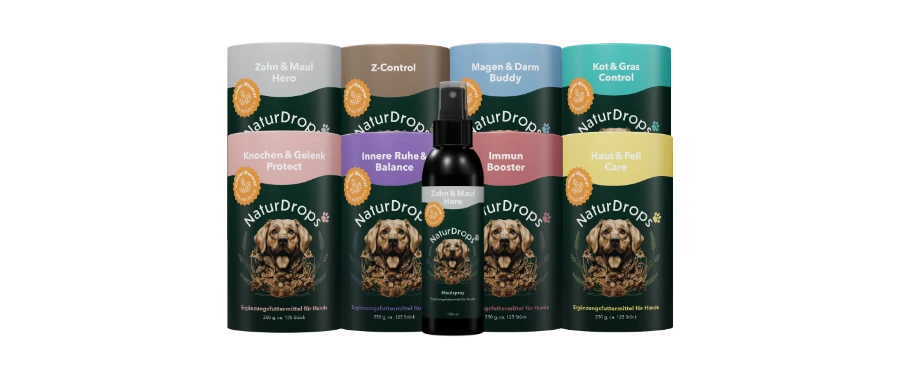
The functional snacks from NaturDrops are also based on this principle: all Drops contain a fermented herbal macerate as their base to functionally support the gut and specifically improve the absorption of the additional active ingredients they contain. This way, not only the composition of a snack is taken into account, but also how well the body can actually utilize it.

Prebiotic effect of fermented herbs
A particular advantage of fermented herbs lies in their prebiotic effect. Prebiotic components serve as food for beneficial gut bacteria and thus support a stable balance in the gut. This has an effect on various areas of canine health:
1) More efficient digestion
A stable gut ensures that food components are digested evenly and gently. This can help
- reduce flatulence and soft stools
- improve feed utilization
- relieve the digestive tract as a whole
2) Better nutrient absorption (bioavailability)
A healthy gut environment is a prerequisite for vitamins, minerals, and plant-based active ingredients to actually be absorbed and used by the body. Good ingredients only deliver their benefits when the gut can utilize them.
3) Support for the immune system
A large part of the immune system is located in the gut. A balanced gut environment can
- support the natural defense function
- make the body more resilient to external stresses
4) Influence on well-being & behavior
The gut is in close communication with the nervous system. A stable gut flora can have a positive effect on
- inner balance
- stress processing
- general well-being
5) Positive effects on skin & coat
When nutrient utilization is stable, important building blocks for skin health, coat structure, and coat shine can be better provided. Skin and coat problems are often indirectly linked to gut health.
6) Stability in sensitive dogs
Especially in dogs that react sensitively to changes in food, stress, or environmental factors, a balanced gut environment can help stabilize their inner balance.
This is not about quick effects or promises of cures, but about supporting natural processes in the body. Fermented herbs can play a supportive role here by functionally accompanying the gut and creating an environment in which other valuable ingredients can be better used.
Feed supplements are not considered a substitute for a balanced diet, but rather a useful addition within a holistic approach.
Conclusion: True quality shows in utilization
High-quality dog nutrition – just like nutritional supplements for dogs – doesn't end with choosing good individual ingredients. What matters is whether these ingredients can be absorbed and effectively utilized by the body.
Because in the end, what counts is not only what's in the snack, but what benefit the body can derive from it.
Quellen:


