

Nutrition & joint health in dogs: These nutrients can support mobility and cartilage.
Merijo Eileen JordanThis article explains the role nutrition plays in joint health for dogs and highlights the key nutrients. If your dog seems stiff, hesitates to get up, or is less active, certain ingredients like green-lipped mussel, glucosamine, chondroitin, collagen, and omega-3 fatty acids can help support cartilage metabolism and reduce inflammation. We'll also explain why antioxidants and micronutrients like zinc, manganese, and MSM are important for stable joint structures and good mobility.
If your dog seems stiff, hesitates to get up, or suddenly doesn't enjoy walking as much as before, joint problems could be the cause. Older dogs, large breeds, or very active animals are particularly prone to this.
Besides sufficient exercise, joint-friendly activities, and a healthy weight , nutrition plays a crucial role in joint health. Certain nutrients can support cartilage metabolism, influence inflammatory processes, and help maintain mobility for as long as possible.
Below you will find the most important ingredients that are specifically used in modern dog nutrition to support joint health.
Green-lipped mussel
Natural nutrient complex for joints
The New Zealand green-lipped mussel (Perna canaliculus) is a particularly valuable natural source of several joint-supporting nutrients.
It contains, among other things:
- Glycosaminoglycans (GAGs) – important building blocks of the cartilage matrix
- Omega-3 fatty acids with anti-inflammatory properties
- Amino acids and minerals
Glycosaminoglycans are essential for the structure of cartilage and synovial fluid . They support joint lubrication and contribute to smooth joint movement.
Furthermore, the green-lipped mussel can:
- support the cartilage structure
- promote the regeneration of joint tissue
- contribute to mobility and joint function
Studies show that extracts from green-lipped mussels can improve mobility and activity levels in dogs with osteoarthritis.
Glucosamine & Chondroitin
Building blocks for cartilage and joint structure
Glucosamine and chondroitin are substances naturally produced by the body and are among the most important components of cartilage tissue. They play a central role in cartilage metabolism and in the stability of the joint structure .
Glucosamine serves as a precursor for the formation of glycosaminoglycans and proteoglycans , which are important components of the cartilage matrix. These molecules help bind water in the cartilage and ensure that the tissue remains elastic and resilient.
Chondroitin works in a complementary way by:
- supports water retention in the cartilage
- improves the shock absorption of the joints
- can slow down the breakdown of cartilage structures
Together, both substances help to support cartilage metabolism and maintain the resilience of the joints .
Collagen
Structural protein for joints, ligaments and tendons
Collagen is the most important structural protein of connective tissue and is found in large quantities in:
- cartilage
- tendons
- ribbons
- Bone
- skin
before.
Collagen type II, in particular, is a key component of the cartilage matrix. An adequate supply of collagen-forming amino acids can help stabilize joint structure and promote mobility .
Collagen also supports:
- the stability of the joint structures
- the resilience of ligaments and tendons
- the elasticity of the cartilage

Omega-3 fatty acids (EPA & DHA)
Omega-3 fatty acids are among the best-researched nutrients for inflammatory processes in the body.
Especially eicosapentaenoic acid (EPA) and docosahexaenoic acid (DHA) from fish oil can:
- Reduce pro-inflammatory messenger substances
- Reduce joint inflammation
- Positively influences pain and stiffness
Several studies show that dogs with osteoarthritis are often more active and exhibit less lameness when fed an omega-3-rich diet .
MSM - Methylsulfonylmethan
Organic sulfur source for connective tissue
MSM (methylsulfonylmethane) is a natural organic sulfur compound that is frequently used in joint support.
Sulfur is an important component of many structures in the body, especially in connective tissue, cartilage and keratin structures .
MSM can contribute to this:
- to support cartilage metabolism
- to promote collagen formation
- to improve the stability of connective tissue
Since sulfur is also involved in the formation of collagen and keratin , MSM plays an important role in the structure and resilience of joints .
Herbal support for joint function
In addition to classic joint nutrients, certain plant-based ingredients can also play a supporting role.
turmeric
Turmeric contains the secondary plant compound curcumin , which is known for its antioxidant and anti-inflammatory properties.
Turmeric is used in dog nutrition to:
- to support the inflammatory balance in the body
- Stabilizing joint function under load
- to reduce oxidative stress
Devil's Claw
Devil's claw (Harpagophytum procumbens) is traditionally used in herbal medicine to support the musculoskeletal system.
Their ingredients can help:
- to support the movement function
- to promote joint mobility
- to improve well-being under stress

Antioxidants and micronutrients
In addition to specific joint substances , vitamins and trace elements also play an important role in the health of the musculoskeletal system.
Important examples include:
- Vitamin E – protects cell membranes from oxidative stress
- Vitamin C – important for collagen formation
- Zinc – supports cell regeneration and tissue repair
- Manganese – involved in the formation of cartilage tissue
Antioxidants help to neutralize free radicals that can be generated during inflammatory processes in the joint.
Nutrition as a building block for greater mobility
Of course, no food alone can replace veterinary treatment for serious joint diseases. However, targeted nutrient supply can make an important contribution to:
- to support joint cartilage
- to influence inflammatory processes
- To maintain mobility for as long as possible
Especially for older dogs or particularly active four-legged friends, a functional diet with joint-supporting ingredients can be beneficial.
👉 Our tip for active dogs:
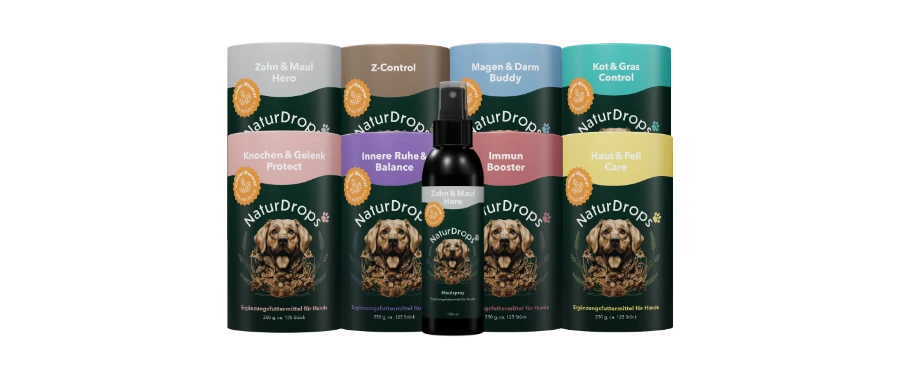
With the functional snack Bones & Joint Protect, your dog can be specifically supplied with important nutrients such as green-lipped mussel, omega-3 fatty acids and collagen-forming building blocks – naturally, without artificial colors and flavors and developed for modern, health-conscious dog nutrition.

Sources:
Quellen:


